

Nepal flash floods kill at least 19 while more than 380 visitors stay unaccounted for
The toll from catastrophic flash flooding that tore through a mountainous Nepali district along the border with Tibet rose to at least 19 dead on Wednesday, as rescuers raced to lo

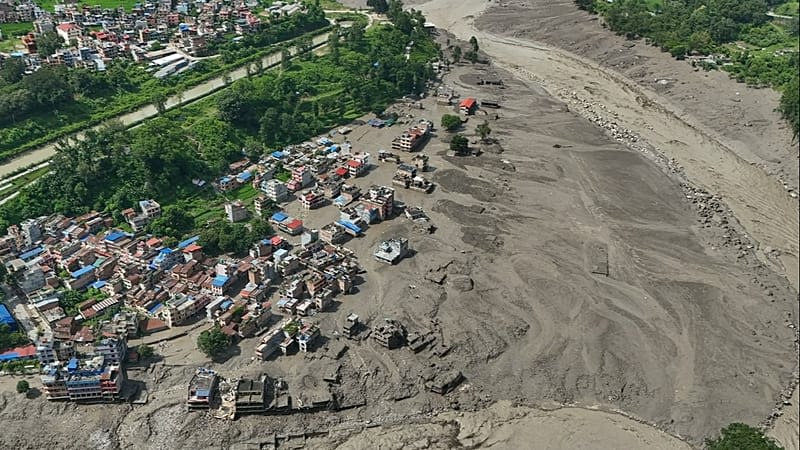
The toll from catastrophic flash flooding that tore through a mountainous Nepali district along the border with Tibet rose to at least 19 dead on Wednesday, as rescuers raced to locate more than 380 people — most of them foreign visitors — who disappeared when raging water swept through Himalayan valleys.
Nepal's Tourism Board said an initial count gathered from tourism operators and travel firms had pinpointed 384 travellers missing across the affected zones, comprising 291 foreign nationals and 93 Nepali citizens. Officials emphasised that verification work was under way to establish the whereabouts of everyone on that list.
"Nineteen bodies have been recovered so far," national police spokesperson Abi Narayan Kafle said, describing intense coordination of rescue and relief operations. He added that a significant number of police personnel were themselves out of contact, a sign of how severely the disaster had disrupted communications and access.
Videos posted by police and bystanders on social media captured violent torrents of sediment-heavy water smashing through gorge terrain in the Himalayan district abutting China. One witness, Suman Chalise, a 34-year-old teacher reached by AFP in Nuwakot district, recounted seeing the surge carry away eight or nine trucks alongside homes and people, calling the scene absolutely heart-wrenching and unlike any devastation he had previously encountered.
Kafle acknowledged earlier that the full scope of the destruction remained unclear, though he said communities dwelling close to riverbanks had already been cautioned to move elsewhere. Photographs from the aftermath showed shattered dwellings and battered vehicles lining the banks of the Trishuli River in Nuwakot.
The Nepali Army announced it had sent helicopters plus dedicated disaster response teams into the zone, and authorities confirmed that several major highways had been shut, further hampering movement in the region.
Critical infrastructure also took a severe beating. The Nepal Electricity Authority estimated that roughly 430 megawatts of generating capacity, drawing on both hydropower stations and solar facilities, had been destroyed, stating that production, transmission and distribution assets were all damaged and electricity delivery interrupted as a result.
Specialists began piecing together what triggered the event. Sarthak Shrestha, a remote sensing and geo information analyst at the Kathmandu-based International Centre for Integrated Mountain Development, said early assessment found no irregularities across the frontier on China's side, and that researchers believed a rock-ice avalanche inside Nepal had obstructed the Lhende river, setting off the cascading flood.
Across the boundary, Chinese state broadcaster CCTV reported Wednesday that a mudslide originating on the Nepalese side had produced significant casualties and missing persons at the Gyirong Port crossing point in Tibet. Footage aired by the network depicted fast-moving currents dragging tree limbs and rubble across a drowned roadway.
Chinese President Xi Jinping demanded "all-out" rescue operations, according to the official Xinhua news agency, which supplied no figures for injuries or fatalities on the Chinese side. Citing CCTV, Xi said the most pressing priority was doing everything possible to search for and rescue the missing, treat injured people quickly and reduce casualties to the greatest extent achievable.
Traffic officials in Tibet's Shigatse region posted a warning on social media Wednesday that roads nearby faced mudslide dangers and were unsafe for travel. Xinhua also recalled that in July of the previous year, seventeen people vanished when a mudslide struck close to the same Gyirong Port crossing.
Seasonal downpours between June and September regularly drench South Asia, and the monsoon reliably brings deadly floods and landslides to Nepal and its neighbours each year, a pattern that this week's catastrophe has once again illustrated in tragic fashion.
What's Your Reaction?
 Like
0
Like
0
 Dislike
0
Dislike
0
 Love
0
Love
0
 Funny
0
Funny
0
 Wow
0
Wow
0
 Sad
0
Sad
0
 Angry
0
Angry
0


Comments (0)