

Germany's Housing Slump Has Cost Its Economy Dearly, New Study Finds
Germany's deep downturn in residential construction has taken a measurable toll on the country's economy, stripping 0.6 percentage points from gross domestic product, according to

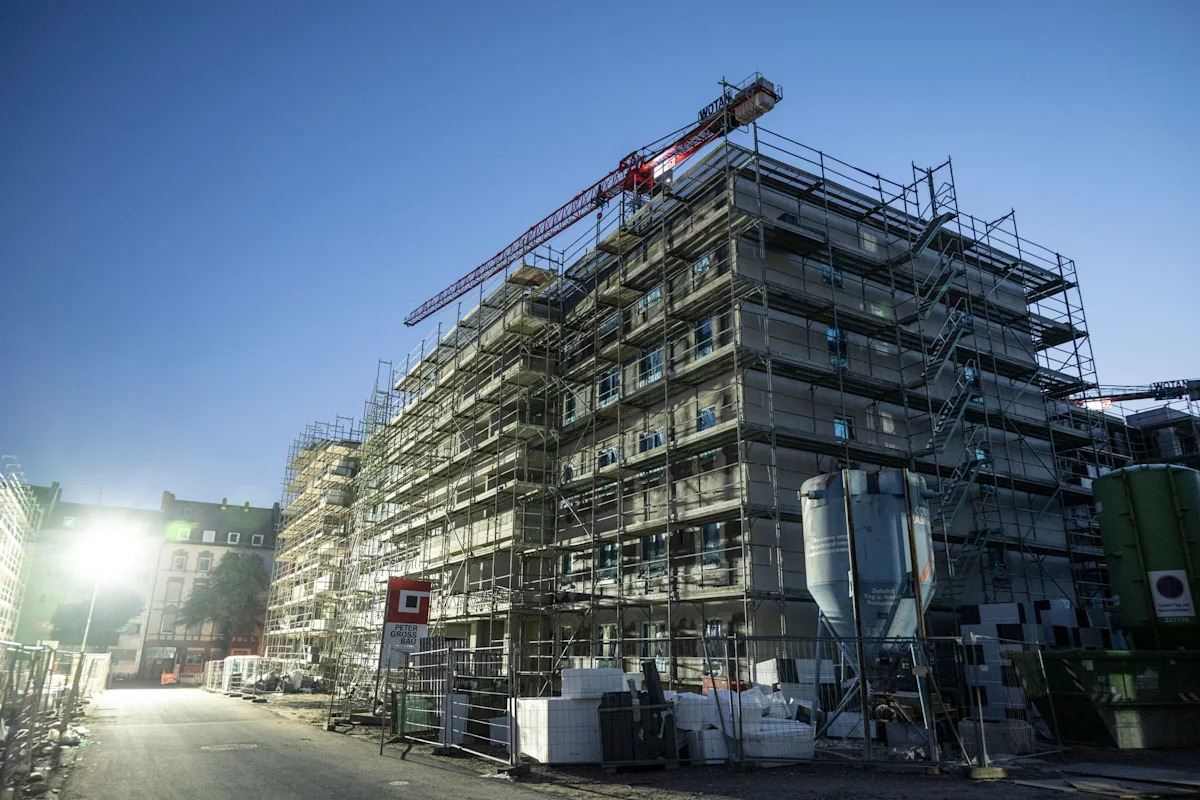
Germany's deep downturn in residential construction has taken a measurable toll on the country's economy, stripping 0.6 percentage points from gross domestic product, according to research published on Wednesday.
The study, titled Construction Monitor 2026, was compiled by the Pestel Institute for the Federal Association of German Building Materials Retailers. It estimates that roughly 84,600 fewer apartments and houses were completed in 2025 than in 2023, marking a steep contraction across two years.
That decline translates into an estimated €26.9 billion ($31.4 billion) in lost revenue for the construction sector over the period, the researchers calculated. The drag also filtered through to public coffers, with tax receipts coming in about €7 billion below where they otherwise would have stood.
To gauge the damage, the institute measured actual output against a scenario of "stable construction activity" — essentially, what the sector would have delivered had completions held at around 300,000 units per year, in line with earlier levels. Official figures show only 206,600 dwellings were actually finished in 2025, according to the Federal Statistical Office.
"Economic growth only works with more housing construction," said Matthias Günther, who heads the Pestel Institute.
Beyond the immediate economic hit, the study highlights a structural gap: Germany is short approximately 1.35 million homes. The institute arrived at that figure earlier this year in research conducted for the Social Living Alliance, and it warns the scarcity is increasingly acting as a brake on the labor market.
In regions with strong economies, employers are struggling to fill open positions because prospective workers cannot secure housing they can afford nearby, the analysis found. Berlin alone is missing at least 58,000 dwellings and Hamburg about 23,000, while the gaps are far larger in the biggest states — 364,000 in North Rhine-Westphalia, 220,000 in Bavaria and 201,000 in Baden-Württemberg.
"People don't move to a new place of work if they can't find a home there that they can also afford," Günther said. He argued that this dynamic was suppressing growth and eroding prosperity more broadly.
There are tentative signs of a turnaround on the supply side. Building permits climbed 15.1% in the first half of 2026 compared with the same period a year earlier, reaching 126,300 units, per the Federal Statistical Office.
Industry representatives, however, remain downbeat about the full year. "The collapse in residential construction is catastrophic," said Katharina Metzger, president of the building materials retailers' association, forecasting just 185,000 newly built homes for 2026 — another substantial drop.
Metzger sharply criticized plans in Berlin to trim housing construction support by €1.4 billion, which would leave only €2 billion in subsidies available in 2027. Rather than retrenching, she said, policymakers should commit to dependable, sustained funding.
She also urged swift adoption of the proposed streamlined construction standard known as Type E, under which apartment blocks of up to 12 units could go ahead without individual planning approval, provided developers adhere to the applicable development plan. --- END ---
What's Your Reaction?
 Like
0
Like
0
 Dislike
0
Dislike
0
 Love
0
Love
0
 Funny
0
Funny
0
 Wow
0
Wow
0
 Sad
0
Sad
0
 Angry
0
Angry
0






Comments (0)